ECG + PPG
Research into electrical and optical cardiac signals and their timing relationships.
Exploring the future of cardiac monitoring with ECG, PPG, supporting biosensors, on-device (AI) TinyML, and confidence-aware AI.
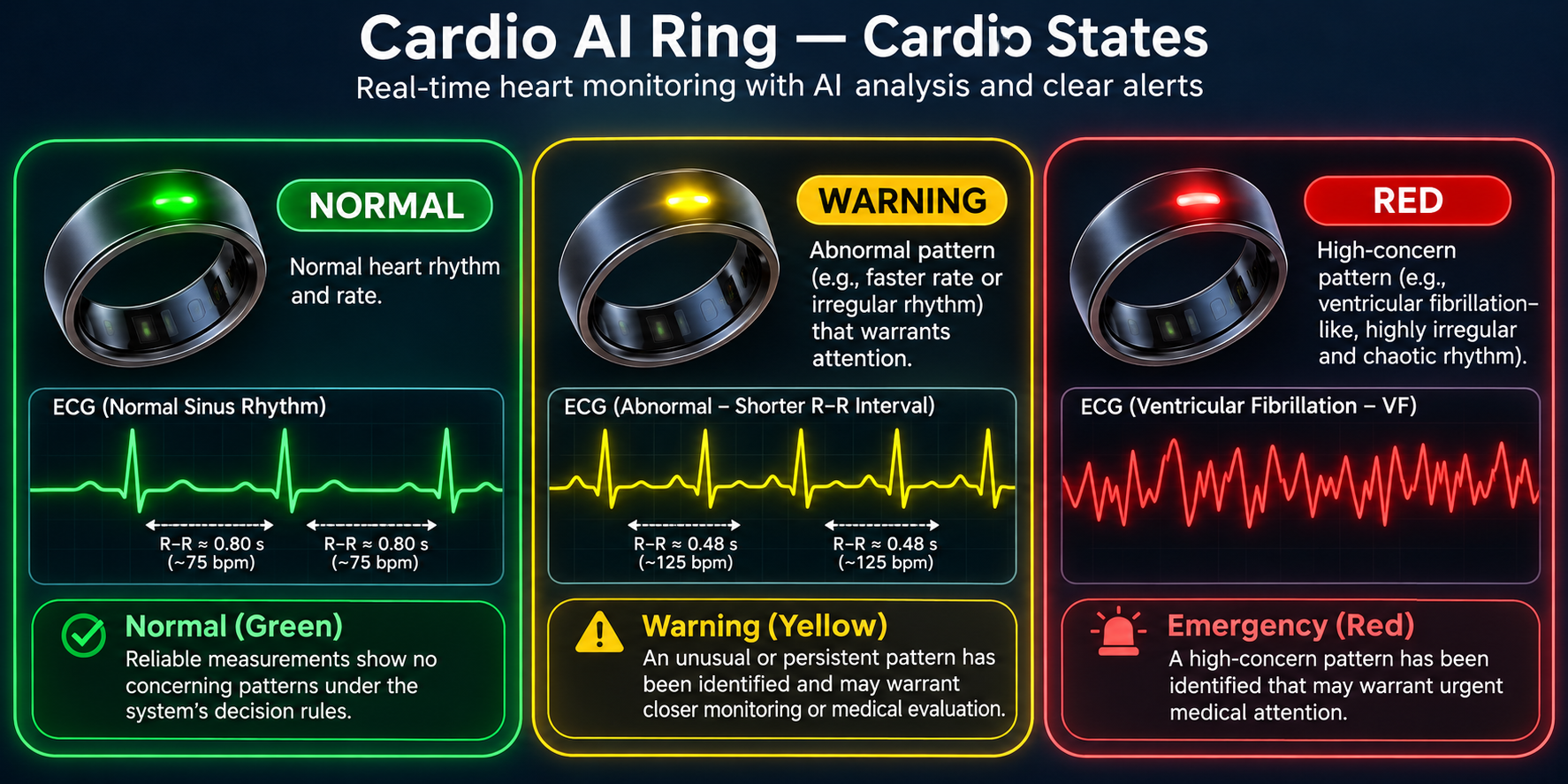
Conceptual illustrations only. ECG traces are illustrative, not actual measurements. The Cardio AI Ring is a research prototype and is not validated to identify ventricular fibrillation or provide emergency monitoring.
Research into electrical and optical cardiac signals and their timing relationships.
Lightweight experimental on-device inference informs an evidence-aware decision engine.
Motion, temperature and EDA/GSR investigated as supporting measurements.
Rather than treating every sensor reading as reliable, our research investigates signal quality, personal baselines, additional measurement when evidence is insufficient, and conservative response logic.
Initial priorities include AFib-like irregularity, fast and slow heart rates, and selected other rhythm patterns.
From sensor bench tests and embedded software to miniaturization and structured validation.
Exploring engineering, research, semiconductor and manufacturing partnerships.
For engineering, research and manufacturing inquiries.
Cardio AI Ring is an experimental research-stage concept. It is not clinically validated to diagnose or predict cardiac conditions, is not FDA-cleared, and must not be relied on for medical decisions or emergency monitoring.
Our proposed architecture combines on-device (AI) TinyML, personalized physiological baselines, cross-sensor corroboration and explicit decision rules. When measurements are unreliable, it can withhold a conclusion rather than guess.
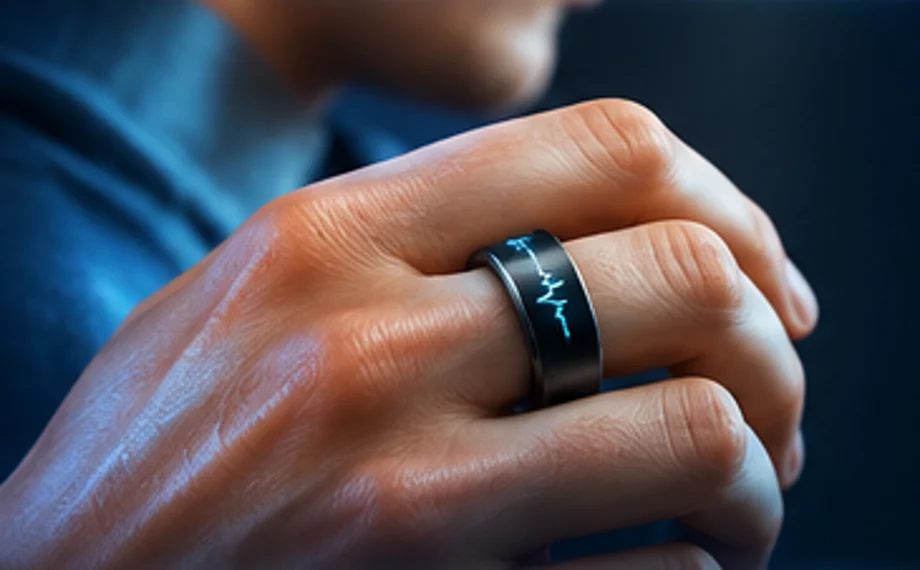
How AI decision-making works →Conceptual imagery of the single-ring form factor and physiological monitoring.
A proposed companion app would connect to the Cardio AI Ring over Bluetooth Low Energy (BLE), display physiological measurements and ECG/PPG waveforms, and present clear, evidence-aware status indications.
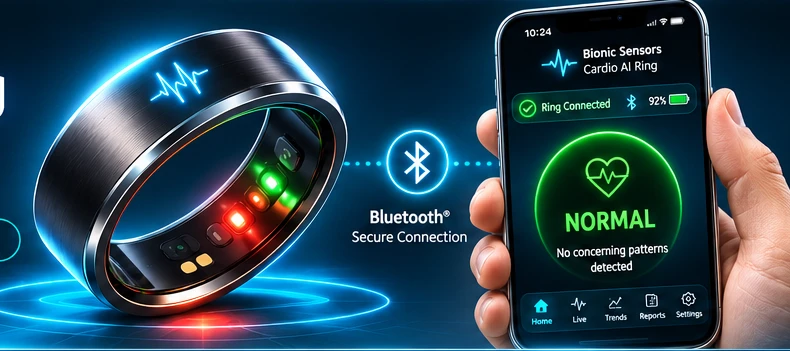
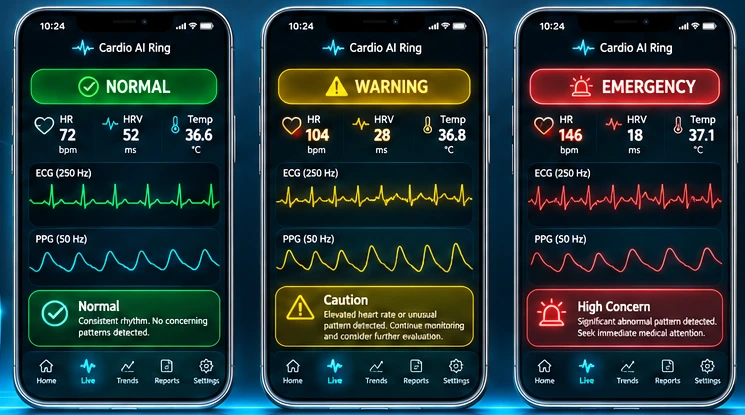
Concept screens only. Displayed measurements and waveforms are illustrative, not recorded patient data. Bluetooth connectivity, app features, alert thresholds, and classifications are proposed and have not been clinically validated. This product is not FDA-cleared and must not be relied upon for diagnosis or emergency monitoring.
The Cardio AI Ring research roadmap combines electrical and optical cardiac signals with physiological and motion context. Individual sensor modules are being evaluated; full integration and clinical performance remain unvalidated.
Individual sensor illustrations are conceptual and do not depict finalized production hardware or exact component packages.
Investigates heart rhythm and waveform features through an electrical sensing channel.
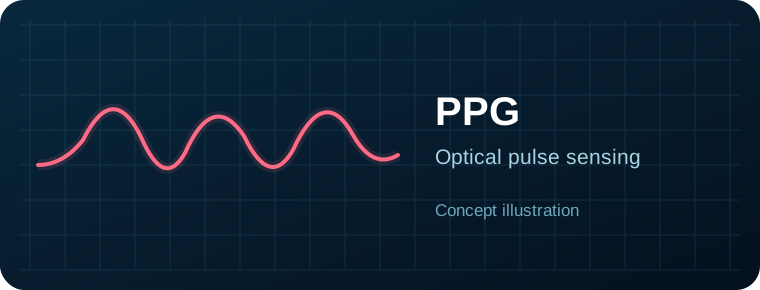
Observes blood-volume pulse patterns and offers complementary evidence to ECG.
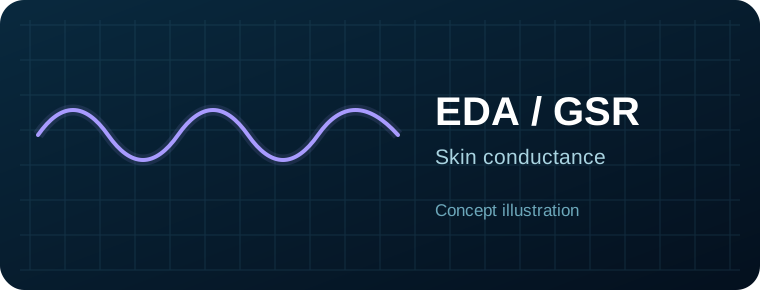
Explores electrodermal changes associated with autonomic arousal as contextual evidence.
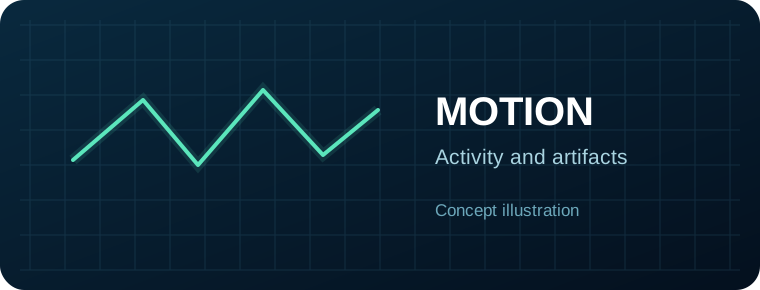
Accelerometer and gyroscope signals help flag movement-related measurement artifacts.
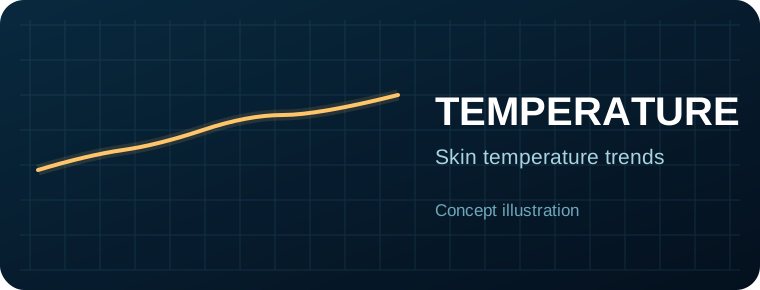
Tracks temperature changes that may support longitudinal baseline interpretation.
Conceptual architecture only. Sensor capabilities, integrated operation, AI classification, and mobile alerts have not been clinically validated. The system is not intended for emergency monitoring.
The Cardio AI Ring research design explores an easy-to-understand status system. Each proposed state reflects the decision engine's interpretation of available signals—not a medical diagnosis.
Green · No current concern identified
Available, sufficiently reliable measurements do not meet the proposed thresholds for a concerning pattern. This does not guarantee that the wearer is healthy or rule out a cardiac condition.
Yellow · Potential concern
An unusual, sustained, or corroborated physiological pattern may warrant attention. The proposed app could prompt repeat measurement or recommend contacting a healthcare professional.
Red · High concern
A proposed high-priority alert for patterns that may warrant urgent evaluation. This indication cannot confirm a medical emergency, and the experimental ring must never be relied on to detect or rule one out.
When contact is poor, movement interferes, or signals disagree, the system may withhold a classification rather than make an unreliable judgment.
These are conceptual, unvalidated alert states. The Cardio AI Ring is not FDA-cleared and is not intended for diagnosis, treatment, or emergency monitoring. If someone has symptoms of a medical emergency, they should seek emergency assistance regardless of any device status.
The Cardio AI Ring concept combines visible LED indicators, an optional vibration motor, and Bluetooth communication with a companion smartphone app to make proposed status changes easier to notice.
Indicates that available measurements do not currently trigger the proposed concern rules. Not a guarantee of cardiac health.
Indicates a potentially unusual or persistent pattern. The app could show an explanation and prompt a recheck or medical consultation.
Proposed urgent-priority indication accompanied by a noticeable vibration pattern and smartphone alert, if supported and enabled. This is not a validated emergency detector.
Indicates that contact, signal quality, or corroboration is inadequate for a reliable assessment. The app could ask the wearer to adjust the ring or repeat measurement.
Proposed emergency workflow: a high-concern event could trigger a red LED and vibration on the ring, followed by a notification in the connected phone app. With the user's explicit opt-in and appropriate phone messaging capabilities, the app could offer an SMS notification to a designated contact. The ring itself does not send SMS directly.
All LED, vibration, Bluetooth alert, and SMS behaviors are planned concepts, not verified product functions. SMS delivery requires compatible smartphone functionality, permissions, and network service; messages are not guaranteed. The experimental device is not intended for emergency monitoring or as a substitute for calling emergency services.